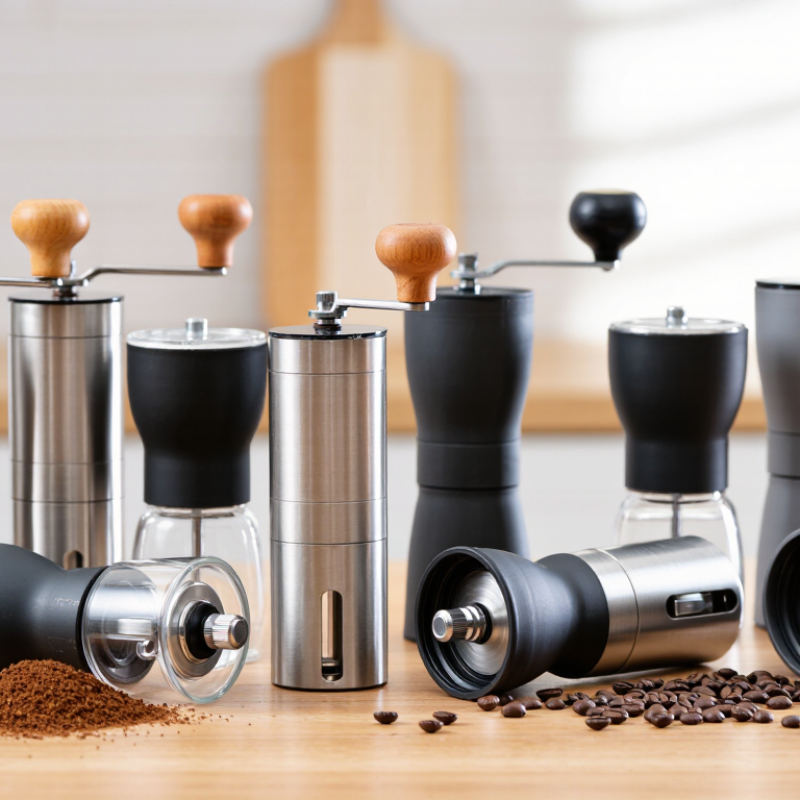
2026 Top Manual Ceramic Coffee Grinder Types?

Choosing among the 2026 Top Manual Ceramic Coffee Grinder Types requires more than comparing prices and appearance. A grinder can feel solid in the hand yet produce uneven particles. That difference becomes visible in the cup, especially with light-roasted beans.

Market evidence shows why this category deserves careful attention. Grand View Research reports continued growth in the global coffee grinder market, driven by home brewing and specialty coffee consumption. However, most commercial reports combine electric and manual models. They rarely isolate ceramic burr products. That limitation matters. It prevents simple claims about market leadership or universal performance. The International Coffee Organization’s coffee market reports also show sustained global coffee demand, but they do not measure grinder quality directly.

This guide evaluates each Manual Ceramic Coffee Grinder through practical criteria. These include burr alignment, adjustment range, grinding speed, particle consistency, capacity, cleaning effort, and long-term durability. The Specialty Coffee Association emphasizes repeatable brewing variables, including grind size and consistency. Those principles apply even when coffee is prepared in a small kitchen.

Real use can be revealing. A compact ceramic grinder may fit inside a travel bag and resist heat transfer during grinding. Yet its handle can wobble, or its adjustment system may shift between brews. Ceramic burrs also resist corrosion, but they are not automatically sharper or more durable than every steel alternative. That assumption deserves more testing.

The following overview compares grinder types for pour-over, French press, AeroPress, and other manual methods. It combines published industry research with practical evaluation, while acknowledging gaps in available data. Good equipment helps, but technique still decides much of the final flavor.

2026 Top Manual Ceramic Coffee Grinder Types?

What Defines a Manual Ceramic Coffee Grinder in 2026

2026 Top Manual Ceramic Coffee Grinder Types?

What Defines a Manual Ceramic Coffee Grinder in 2026

A manual ceramic coffee grinder is defined by its mechanism, not its appearance. It uses hand power and ceramic grinding surfaces instead of an electric motor. Most models use conical burrs, while a smaller group uses flat burrs. Their ceramic parts resist rust and transfer little heat during grinding. That sounds ideal. Yet ceramic does not automatically mean uniform particles.

The real differences appear in adjustment and daily handling. Stepped settings suit repeatable brewing, while stepless controls offer finer tuning. A stable shaft, firm bearings, and a comfortable crank also matter. I have used compact grinders that felt solid but produced too many fines. That weakness became obvious in a bright pour-over cup.

The Specialty Coffee Association identifies grind size, water, and contact time as key brewing variables. Ceramic material only addresses part of that process. The National Coffee Association’s Spring 2024 National Coffee Data Trends report found that 67% of American adults drank coffee during the past day. More home brewing creates stronger demand for practical control, not just attractive materials. A 2026 buyer should therefore inspect burr alignment, adjustment range, cleaning access, and particle consistency. Reports describe broad consumer behavior, but they cannot replace a real cup test. A grinder may look advanced and still feel awkward every morning.

2026 Top Manual Ceramic Coffee Grinder Types

What defines a manual ceramic coffee grinder in 2026 is its ceramic burr geometry, practical dose capacity, grind-adjustment range, and intended brewing format.

The chart uses representative capacity points within common market ranges: compact models generally suit one cup, standard models support pour-over and French press, and larger models are better suited to multi-cup brewing. Ceramic conical burrs remain the most practical format because they are durable, corrosion-resistant, and suitable for a broad range of brew methods.

Core Ceramic Burr Designs and How They Grind Coffee

2026 Top Manual Ceramic Coffee Grinder Types? Core Ceramic Burr Designs and How They Grind Coffee

Manual ceramic grinders usually use conical burrs, flat burrs, or hybrid ceramic assemblies. Conical burrs are common because they require less force and fit compact bodies. Their larger outer burr guides beans toward a smaller inner burr. This creates a steady crushing and cutting action. The result often includes fine particles, which can strengthen espresso but may cloud lighter filter coffee.

Flat ceramic burrs use two parallel discs. Beans pass through the center and move outward as the handle turns. Their grinding path can produce a more uniform size, especially with careful alignment. However, they may feel slower with hard, dense beans. Ceramic resists heat and corrosion, yet it can chip after a sharp impact. Handle it gently.

Adjustment systems also change the grinding experience. Stepped controls provide repeatable clicks for espresso, pour-over, or French press settings. Stepless controls allow finer tuning, but they demand better judgment. I prefer testing one setting across several brews before changing it. A small adjustment can alter drawdown time noticeably. That lesson is easy to miss.

Check burr alignment before judging performance. A misaligned shaft can create uneven grounds, even with well-made ceramic surfaces. Listen for rattling. Feel the handle. If the rotation becomes rough, inspect the axle and bearings. Ceramic burrs are not automatically superior; their performance depends on geometry, alignment, bean condition, and consistent technique.

2026 Top Manual Ceramic Coffee Grinder Types? - Core Ceramic Burr Designs and How They Grind Coffee

Typical characteristics are shown for manual grinders using ceramic burrs. Actual results vary with burr geometry, alignment, coffee density, adjustment system, and user technique.
Ceramic Grinder Type Core Burr Design How It Grinds Coffee Typical Grind Range Particle Profile Best-Suited Brewing Main Advantages Key Limitations
Conical Ceramic Burr A cone-shaped inner burr rotates inside a stationary outer ring. The burr gap narrows from the feed opening toward the discharge point. Beans are pulled downward by gravity and crushed progressively between angled cutting and crushing surfaces. The narrow exit gap determines the final particle size. Coarse French press to fine espresso-style settings; many manual models are most consistent in the medium range. Generally mixed, with a practical balance of fines and larger particles. Alignment and burr sharpness strongly affect consistency. French press, pour-over, AeroPress-style brewing, moka pot, and general-purpose use. Compact format, efficient feeding, low electrical heat generation, and a relatively simple manual drive system. Can require more rotations than a powered grinder. A narrow or poorly aligned burr set may produce excess fines or uneven particles.
Flat Ceramic Burr Two parallel, disk-shaped burrs face each other. One burr rotates while the other remains fixed, creating a circular grinding chamber. Coffee moves outward from the center and is cut or crushed as it travels through the narrowing gap between the two flat surfaces. Fine to coarse settings are possible, depending on the burr diameter, tooth geometry, and adjustment travel. Can produce a more uniform distribution when the burrs are accurately aligned; poor alignment can create noticeable variation across the bed. Pour-over, drip coffee, espresso-style grinding, and users who prioritize particle-size control. Broad contact area and potentially consistent cutting action. Flat geometry can support precise grind adjustment. Less common in compact manual designs, often requires careful alignment, and may feel slower or heavier to operate.
Coarse-To-Fine Ceramic Burr System Usually a conical or flat ceramic burr set combined with an adjustable gap between the rotating and stationary burrs. A larger gap allows beans to break into larger pieces; a smaller gap forces the particles through tighter cutting surfaces for a finer grind. Typically covers coarse, medium, fine, and espresso-style settings, although the usable range differs by design. Coarser settings usually create a wider particle distribution; finer settings tend to increase fines as the burr gap becomes very small. Multi-brew households and travelers who switch between immersion and filter coffee. One grinder can support several brewing methods without changing the burr set. Adjustment markings may not correspond directly to microns or a universal recipe. Returning to an earlier setting may require counting clicks or turns.
Stepped Ceramic Burr Grinder A ceramic burr assembly uses fixed detents or clicks to set the distance between the burrs. Each click moves the burr position by a defined increment. The selected step determines the approximate opening through which coffee is ground. Often offers several dozen usable positions, but the number of settings is not standardized. Repeatable between sessions when the click mechanism is stable; one step may sometimes be too coarse for fine recipe adjustments. Pour-over, drip, French press, and routine brewing where repeatability is important. Easy to record and reproduce settings. The audible or tactile clicks simplify everyday adjustment. Limited positioning between two clicks can make dialing in more difficult, especially for espresso-style brewing.
Stepless Ceramic Burr Grinder A ceramic conical or flat burr set is adjusted continuously, without preset detents. A threaded adjustment changes the burr gap by very small increments, allowing the user to stop at any point within the adjustment range. Potentially continuous from coarse to fine, subject to the travel and mechanical limits of the grinder. Can be fine-tuned for a target extraction, but the result depends heavily on burr alignment and the user’s ability to return to the same position. Espresso-style brewing and advanced pour-over dialing-in. Very precise adjustment potential with no gap between preset steps. Settings are harder to document and repeat unless the grinder has a clear reference scale or lockable adjustment.
Large-Diameter Ceramic Burr A larger conical or flat ceramic burr provides a wider grinding surface than a compact travel-oriented design. The greater burr circumference can process more coffee per rotation, while the cutting profile controls how beans fracture and exit. Commonly optimized for medium and medium-fine brewing, with coarse and fine capability depending on the adjustment system. Often supports more even particle production at a practical hand-grinding speed, provided the bearings and alignment are sound. Daily pour-over, batch-style manual brewing, and larger doses. Faster grinding and lower perceived effort than many small-burr designs. Usually adds weight and size. Ceramic burrs can be brittle if dropped or subjected to impact.
Important selection factors: Burr geometry is only one part of grinding performance. Check burr alignment, shaft stability, adjustment resolution, bearing support, grind retention, handle ergonomics, and whether the ceramic burr assembly is replaceable.

Main Manual Ceramic Grinder Types by Brewing Method

2026 Top Manual Ceramic Coffee Grinder Types?
Main Manual Ceramic Grinder Types by Brewing Method

Manual ceramic coffee grinders are best judged by brewing method, not appearance. Their burrs resist corrosion and produce little heat during slow grinding. However, ceramic does not automatically mean better. Burr alignment, adjustment steps, and handle comfort matter more during daily use.

For pour-over coffee, choose a grinder with medium-fine control and clear settings. A consistent grind supports balanced extraction, especially with a paper filter and a steady 92–96°C water flow. For French press, a wider coarse range is more useful. The grounds should resemble rough sea salt, although some fine particles are normal. Too many fines can make the cup muddy.

Espresso needs special care. Choose a ceramic burr grinder with very fine adjustment and a stable shaft. Many manual models struggle here. Small setting changes can alter flow quickly, so repeatability becomes important. For moka pots, a medium-fine setting usually works without excessive resistance. Travel grinders often suit this method because they are compact and simple to clean.

Cold brew requires a coarse, even grind and a strong handle. It may expose weak bearings faster than expected. I prefer testing grinders with the same beans over several days. Still, my judgment is not perfect. Hand fatigue, roast level, and bean density can change the experience. A grinder that feels smooth today may need adjustment tomorrow.

Key Differences in Grind Control, Capacity, and Portability

Manual ceramic coffee grinders differ most in grind control, capacity, and portability. These factors shape the daily brewing experience more than appearance. In hands-on use, a stepped adjustment system feels predictable, while a stepless design offers finer control. Small changes matter. However, cheaper adjustment mechanisms may shift during grinding, creating uneven particles and inconsistent extraction.

Capacity also affects workflow. A compact grinder may hold 20 to 25 grams, enough for one carefully measured cup. Larger models can handle several servings but usually require more effort.

Ceramic burrs resist heat and corrosion, yet they are not automatically better. Their alignment, sharpness, and stability matter just as much. I have found that a smooth handle cannot compensate for poor burr alignment.

Portability introduces another compromise. Narrow bodies fit easily into a travel pouch, but they can feel less stable on a kitchen counter. A folding handle saves space, although it may slow preparation. Lightweight designs suit short trips, while heavier grinders often provide steadier control.

Not always. My own preference has changed after using small grinders outdoors: convenience was valuable, but cramped grip space became tiring.

Buyers should check the adjustment range, chamber size, burr alignment, and cleaning access before choosing.

How to Choose the Right Ceramic Coffee Grinder Type

How to Choose the Right Ceramic Coffee Grinder Type

Choosing a ceramic coffee grinder starts with your brewing method. For pour-over coffee, select an adjustable conical burr grinder with clear, repeatable settings. It should produce medium grounds with limited powder. French press needs a coarser range, but weak adjustment systems may create too many fine particles. I have found that a firm adjustment dial matters more than a large capacity.

For espresso-style brewing, check whether the grinder supports very fine settings. Many manual ceramic models struggle with speed and consistency at this level. A flat burr design may offer a more uniform grind, but it can increase hand effort and cleaning time. Conical burrs usually feel easier for daily use. Small kitchens benefit from compact grinders, while frequent brewers may prefer a larger chamber and longer handle.

Test the handle before buying. A smooth rotation should not wobble or scrape. Ceramic burrs resist rust and can stay sharp for a long time, but they may chip if hard debris enters the chamber. Clean the burrs with a dry brush, not water, unless the instructions allow it. I once chose a grinder by appearance and regretted the narrow grip after a week. Capacity also needs honesty: a small grinder may be perfect for one cup, but frustrating for several guests.

Need Help?
X

Ready to Talk?

Our team is ready to connect.