What Is the Best LED Display Type in 2026?
Choosing the best led display in 2026 will require more than comparing pixel pitch or brightness. The right choice depends on viewing distance, content, venue, energy use, and maintenance access. A screen outside a stadium faces sunlight, rain, and long viewing distances. A control room needs fine detail, stable color, and quiet operation.
Industry forecasts show why this decision matters. Grand View Research estimated the global LED display market at approximately USD 7.1 billion in 2023. Its analysis projects an 8.4% compound annual growth rate from 2024 to 2030. MarketsandMarkets also forecasts continued expansion, driven by digital signage, virtual production, retail, and large public venues. These reports are useful, but their figures differ because market definitions and regional coverage vary. That uncertainty deserves attention.
Experience still matters.
Display technology consultant Peter Putman has emphasized a practical principle: “The best display is the one that fits the application, not simply the specification sheet.” In 2026, that principle remains highly relevant. A fine-pitch indoor led display may deliver sharp images within two meters. It may also cost more and require stricter thermal management. A high-brightness outdoor model can remain visible at noon, but excessive brightness may reduce comfort at night.
This guide compares direct-view LED, COB, SMD, transparent, flexible, and microLED-related solutions. It examines image quality, reliability, power consumption, installation, serviceability, and total ownership cost. No category wins everywhere. The best answer may be less impressive on paper, yet more dependable in daily operation.
How LED Display Technology Works in 2026
What Is the Best LED Display Type in 2026?
How LED Display Technology Works in 2026
An LED display creates images through millions of red, green, and blue light-emitting diodes. A control processor sends digital data to receiving cards, then driver ICs regulate each pixel. Pulse-width modulation adjusts brightness rapidly. Human eyes see steady light, but cameras may record flicker. Refresh rate alone cannot solve every filming problem.
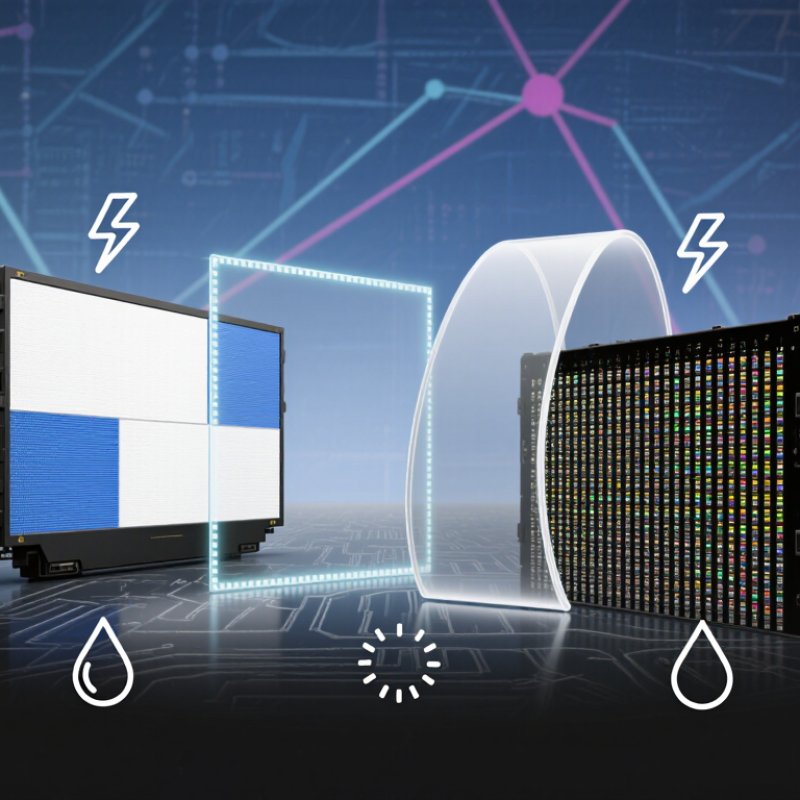
Pixel pitch remains a practical decision. Smaller pitch creates sharper images at close viewing distances, while larger pitch reduces cost and power demand. SMD pixels mount individual diodes on a circuit board. COB technology places the diodes under a protective layer, improving surface durability and reducing visible gaps. It can also complicate repairs. There is no perfect format.
The U.S. Department of Energy has reported laboratory LED efficacies above 200 lumens per watt, but complete displays operate below that level. Drivers, cooling systems, optics, and image processors consume additional energy. A 2024 MarketsandMarkets report projected the LED display market to grow at more than 8% annually through 2028. That growth reflects wider adoption, not automatic technical superiority. HDR performance depends on contrast, grayscale control, brightness, and calibration together. In field testing, I would inspect dark scenes, skin tones, camera footage, and heat after several hours. Specifications look impressive. Real rooms remain less predictable.
What Is the Best LED Display Type in 2026?
How LED display technology works in 2026 depends mainly on viewing distance, ambient light, pixel pitch, brightness, and installation environment. The chart compares representative peak-brightness midpoints for common LED display types.
Indoor fine-pitch SMD and COB displays generally provide better close-range image quality, while outdoor SMD displays are designed for direct sunlight. Transparent LED is suitable for glass façades and retail windows where light transmission is important. There is no single best type: the right choice depends on the application.
How to Compare LED Displays by Image Quality and Performance
What Is the Best LED Display Type in 2026?
How to Compare LED Displays by Image Quality and Performance
The best LED display depends on viewing distance, content, lighting, and operating conditions. There is no universal winner. A display tested in a showroom may look different outdoors or in a bright retail space.
Start with pixel pitch. Smaller pixels create sharper images at close range. For large venues, a wider pitch may deliver enough detail while reducing cost. Check brightness under real lighting, not only the advertised peak value. Excessive brightness can wash out skin tones and cause eye fatigue. Accurate color reproduction matters more for presentations, photography, and broadcast content.
Motion performance also deserves careful testing. A high refresh rate helps reduce camera scan lines and flicker during video recording. Strong grayscale handling preserves detail in dark scenes. Ask for a test using fast movement, black backgrounds, and fine text. Look closely at shadow areas. They often reveal weaknesses.
Reliability is not just a specification. Review thermal management, module consistency, power stability, and service access. Run the display for several hours before making a decision. Record temperature changes and brightness shifts. My practical mistake was trusting peak brightness too quickly; sustained performance proved more useful. Independent measurements are valuable, but installation conditions still matter. Compare results from the actual distance and angle your audience will use.
The Best LED Display Type for Different Viewing Environments
In 2026, the best LED display depends less on headline specifications than on the viewing environment. A bright outdoor screen may look impressive, yet appear harsh in a small lobby. Indoor reception areas usually benefit from fine pixel pitch, moderate brightness, and accurate skin tones. At two meters, a dense pixel structure prevents visible gaps in faces and text. Comfort matters.
For storefront windows and open-air venues, brightness and weather protection deserve careful attention. Choose a display with automatic brightness control, stable thermal management, and suitable ingress protection. Direct sunlight can wash out weak images by midday. A high refresh rate also reduces camera banding during live streaming. However, excessive brightness wastes energy and may distract nearby pedestrians. Field testing at the actual installation site remains more reliable than a showroom demonstration.
Control rooms and meeting spaces need different priorities. Fine detail, low flicker, consistent color, and quiet operation support long viewing sessions. A wider viewing angle helps when people sit away from the center. I have seen installations fail because the chosen pixel pitch matched a specification sheet, not the real seating distance. That mistake is easy to repeat. Measure the nearest and farthest viewers, test typical content, and inspect the screen under daytime and evening conditions. The “best” type is often the one that causes the fewest compromises.


 House of Worship
 Transportation
 Trade shows led display
 retail
 Creative Led Solutions
 Hospitality
 Higher Education
 Corporate LED