What Is a Steel Panel Radiator and How Does It Work?
A Steel Panel Radiator is a compact heat emitter built from pressed steel panels and internal water channels. Hot water enters through the valve, warms the metal surface, and transfers heat into the room. Some heat travels directly to nearby people and furniture. The rest rises as warm air, creating a gentle circulation around the room.
The principle sounds simple. It is not completely simple.
Radiator performance depends on water temperature, panel size, insulation, room layout, and installation quality. EN 442-1 defines testing requirements for radiator heat output, helping manufacturers present comparable performance data. The International Energy Agency reported that buildings consumed around 30% of global final energy in 2022. Heating remains a major part of that demand, especially in colder climates. These figures do not make every radiator efficient automatically. They show why small design decisions matter.
Heating writer Dan Holohan explains the human side of the system: “Radiators don’t heat rooms; they heat people.” His observation is practical, although slightly incomplete. A radiator heats people through radiation, but it also warms air, walls, curtains, and floors. Place one beneath a window, and it can counter a cold downdraught. Cover it with thick furniture, and useful heat may disappear behind fabric.
This guide examines how a Steel Panel Radiator works, how its construction affects output, and which details influence real-world comfort. Manufacturer figures are useful. Your room is the final test.
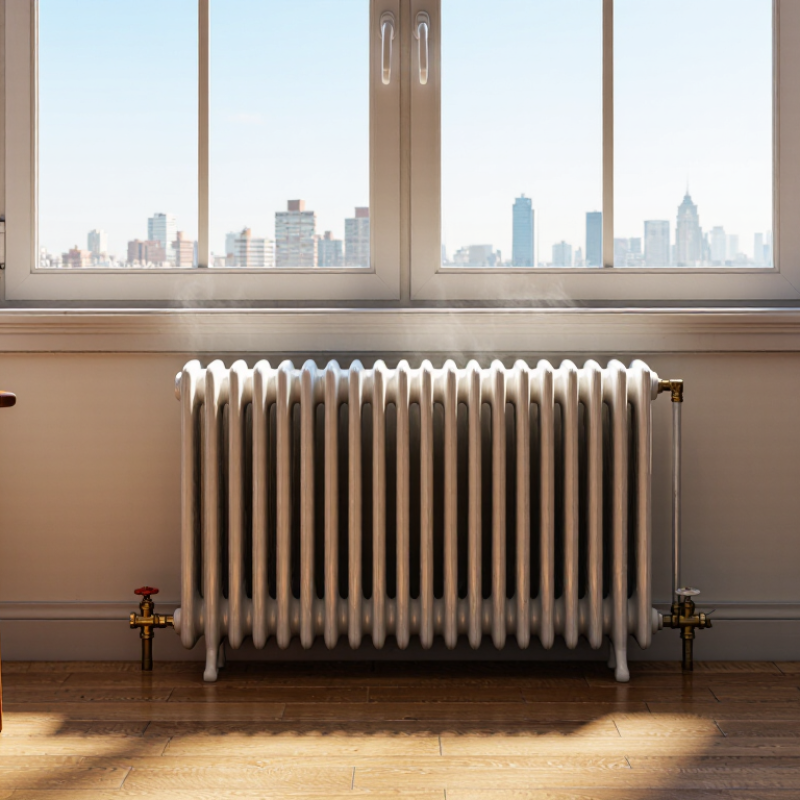
Steel Panel Radiator: Definition, Construction, and EN 442 Classification
A steel panel radiator is a pressed-steel heating unit that transfers hot-water heat into a room. Its construction usually combines flat steel panels with internal convection fins. Water flows through welded channels behind the visible panel. The panel warms first. Air then rises across the fins.
The common Type 11, 21, 22, and 33 labels describe construction, not brand quality. The first digit indicates steel panels. The second indicates finned convection layers. A Type 22 radiator has two panels and two fin layers. It is deeper than Type 11 and usually delivers more heat from a similar wall length.
EN 442-1 sets product requirements, while EN 442-2 defines testing and rating methods. Standard output is commonly reported at 75/65/20°C, producing a 50-kelvin mean water-to-room temperature difference. This reference helps engineers compare products fairly. It does not predict every installation. Actual output changes with water temperature, room size, pipe balancing, and air movement.
The International Energy Agency reported in its 2023 Global Status Report for Buildings and Construction that buildings consumed about 30% of global energy. Efficient heat distribution therefore matters. Yet a larger radiator is not automatically better. Oversizing can reduce cycling, but it may also increase cost and wall depth. A practical selection should use room heat-loss calculations, then verify the EN 442 output at the intended operating temperature. Some product labels appear exact. They still deserve careful checking.
How Steel Panels Transfer Heat Through Convection and Radiation
What Is a Steel Panel Radiator and How Does It Work?
A steel panel radiator uses heated water to warm a room through convection and radiation. Water flows through narrow channels inside the steel panel. The panel surface then becomes warm. It transfers heat directly to nearby objects, including floors, furniture, and people. This direct transfer is radiation, although it does not involve dangerous rays.
Convection works differently. Air touching the heated panel rises naturally. Cooler air moves toward the radiator, warms up, and rises again. This creates a gentle circulation pattern across the room. The process is quiet and usually needs no fan. However, room heating is rarely perfectly even. Furniture, curtains, and poor insulation can interrupt airflow. I have found that a radiator may feel hot while a distant corner remains cool. That detail is easy to overlook.
Tips: Keep the area around the radiator open. Avoid covering it with thick curtains or furniture. Leave a small gap below the panel for air movement. Bleed the radiator if it contains trapped air and heats unevenly. A wall-mounted panel often performs better when positioned beneath a window, where it can counter cool descending air. Still, placement alone cannot fix major insulation problems. Check the room, not only the radiator.
Key Components: 1.2 mm Steel Panels, Waterways, and Convectors
A steel panel radiator transfers heat from hot water into a room through three working parts: steel panels, waterways, and convectors. Many models use 1.2 mm steel panels, giving the radiator a firm surface without excessive weight. Inside, narrow waterways carry heated water from the inlet across the panel. The steel absorbs this heat and releases it through the front surface. Simple, but not effortless.
Convectors are folded steel fins attached behind the panels. They warm the air between the fins, creating a gentle upward flow. You can feel this effect near a cold window. The radiator warms the lower air first, then circulates it around the room. Eurostat reports that space heating represented about 63% of household energy use in the European Union in 2022. Efficient heat distribution matters. EN 442 testing measures radiator output under defined temperature conditions, helping engineers compare models fairly. However, published output can change with water temperature, installation, room insulation, and control settings. That detail is often overlooked. The International Energy Agency also identifies buildings as a major source of global energy demand, reinforcing the value of correctly sized heating equipment. A thicker panel is not automatically better. Waterway design and convector geometry can matter just as much. My practical concern is maintenance: trapped air, sludge, or poor balancing can reduce real performance, even when the radiator meets laboratory specifications.
Heat Output Testing at the EN 442 Standard of 75/65/20°C
A steel panel radiator is a pressed-steel heat emitter with internal water channels and, often, convector fins. Hot water enters the panel, transfers heat through the steel, and warms the room by radiation and air movement. Its certified output depends on water temperature, room temperature, airflow, and installation details.
EN 442-2 tests radiator output at 75/65/20°C. Water enters at 75°C, leaves at 65°C, and the room remains at 20°C. The mean water temperature is therefore 70°C, creating a 50 Kelvin temperature difference. This condition is commonly called ΔT50. Test laboratories measure heat output after reaching thermal stability, following the standard’s controlled procedures. A typical 600 × 1000 mm steel Type 22 panel may produce around 1.7 kW at ΔT50, although its tested geometry can change the result significantly.
The figure looks precise. Real rooms are less tidy. Pipe resistance, trapped air, curtains, wall position, and thermostatic valve settings can reduce delivered heat. CIBSE Guide B1 recommends using calculated room heat loss rather than radiator output alone. Output also falls sharply with lower-temperature heating. The EN 442 calculation method uses a radiator-specific exponent, often close to 1.3, to estimate performance away from ΔT50. At 45/35/20°C, the mean water temperature is 40°C, giving ΔT20; a panel rated at 1.7 kW may deliver only about 0.5 kW. That estimate needs verification against the certified data sheet. The test is authoritative, but it is not a perfect replica of a lived-in room.
Radiator Sizing with ΔT50 Ratings and Room Heat-Loss Data
What Is a Steel Panel Radiator and How Does It Work?
A steel panel radiator heats a room through warm air movement and gentle surface radiation. Hot water passes through internal channels, warming the steel panel and its fins. Cooler air sinks, then rises after heating. This creates a steady circulation beside the radiator. It is simple, but room performance depends heavily on correct sizing.
Radiator output is commonly listed at ΔT50. This means the average water temperature is 50°C above the room temperature. A typical test condition uses 75°C flow, 65°C return, and 20°C indoors. Your system may operate at lower temperatures. In that case, the radiator produces less heat.
Start with a room heat-loss calculation, including wall area, window size, insulation, ventilation, and outdoor design temperature. Select a radiator whose corrected output meets or slightly exceeds that loss. Do not rely only on room floor area. A small, poorly insulated bedroom can lose more heat than a larger internal room.
Tips: Record each room separately. Check windows and cold corners. Ask for the radiator’s correction factor at your actual ΔT. A neat calculation can still miss draughts. I have seen comfortable rooms become chilly after furniture blocked the radiator. Leave space below and above it. Recheck the figures before ordering, because assumptions are rarely perfect.


 House of Worship
 Transportation
 Trade shows led display
 retail
 Creative Led Solutions
 Hospitality
 Higher Education
 Corporate LED


